BRIEF INTRODUCTION:
CCRAS-Regional Ayurveda Research Institute, is a peripheral unit of Central Council for Research in Ayurvedic Sciences (CCRAS) an autonomous body under Ministry of AYUSH, Govt of India. The CCRAS-RARI, Thiruvananthapuram has a long antecedent history before its formal establishment in 1975 which dates back to the as early as the 1960’s. Since 1964 various grant-in-aid research units had functioned in rent free building provided by Govt. of Kerala at Trivandrum under Composite Drug Research Scheme (CDRS). As a result of amalgamation of these units Regional Research Institute (Drug Research) was established in 1975 and functioned to coordinate national level multi-disciplinary research activities. The institute is located at Thiruvananthapuram-the capital city of Kerala and comes under Poojappura ward of the Corporation of Thiruvananthapuram.
Major milestones related to the Institute
15th January 1975 : Establishment of Regional Research Institute (Drug Research)
04th August 2003 : Transfer of 01.54.500 acres of land by Govt of Kerala to RRI-(DR), Poojappura, Thiruvananthapuram free of cost.
2010 : Renamed to Ayurveda Research Institute for Mother and Child Health Care (ARIMCHC), Thiruvananthapuram
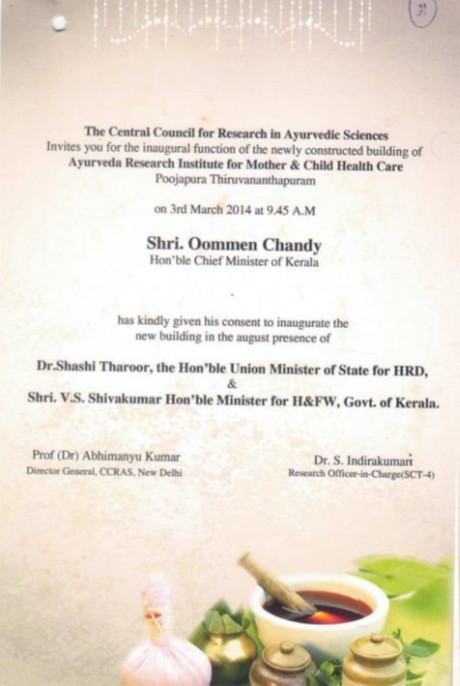
03rd March 2014 : Inauguration of new building of the institute by Shri Oommen Chandry, Hon’ble Chief Minister of Kerala
12th April 2016 : Renamed to Regional Ayurveda Research Institute for Lifestyle Related Disorders (RARILSD), Thiruvananthapuram
22nd January 2019 : Inauguration of newly constructed 2nd Floor (Pay ward) of the building of RARILSD by Shri.Shripad Naik, Hon’ble Union Minister of State (I/C), Ministry of AYUSH, Govt of India
22nd December 2020 : Reorganized and Renamed as Regional Ayurveda Research Institute (RARI), Thiruvananthapuram
16th November 2023 : Institute Laboratory got accredited with NABL-M(EL)T certification.
06th January 2026 : Institute got Bureau of Indian Standards (BIS) Certification IS/ISO 9001:2015
Vision
To develop scientific evidence in Ayurvedic Principles, drugs and therapies by integrating ancient wisdom through scientific innovations related to diagnostics, preventive, promotive as well as treatment methods.
Mission
To provide general OPD/IPD serving the public and conduct any other assignments of national importance related to R&D in Ayurveda

Facilities available
- OPD
- General OPD : All working days
- Lifestyle OPD : All working days Medicines are made available free of cost to the
Medicines are made available free of cost to the patients
- IPD
- Bed strength : 30
- General Wards (Male and Female), Pay wards
- Well-equipped Panchakarma Theatres
- Treatment facilities are provided as per CCRAS guidelines
· Pharmacy
The Institute maintains a well-equipped pharmacy and dedicated medicine storage facility to support its clinical and research activities. The pharmacy section ensures the availability of authentic Ayurvedic formulations that are procured from approved Good Manufacturing Practices (GMP) certified companies identified by CCRAS Hqtrs
· Clinical Laboratory facility
The Institute have an NABL Accredited (NABL-M(EL)T-02378) Pathology and Biochemistry Department providing high-quality diagnostic services to the patients attending the Institute. It is equipped with advanced, fully automated systems that ensure precision and efficiency across a wide range of biochemical, hematological, immunological, and microscopic investigations.
· Library
The Institute have a well-furnished library located on the second floor of the hospital building, houses around 2,255 reference books across various disciplines, 954 CCRAS publications and 150 CDs are also available for sale.
Research Activities
Intra Mural Research projects: Ongoing – 16 (Nos)
- Clinical Evaluation of Ayurvedic Regimen (Virechana Karma followed by Oral administration of Kankayana vati, Kanchanara guggulu and Kumaryasava) in the management of polycystic ovarian syndrome – A Randomized controlled open label Clinical Trial
- A prospective pragmatic observational study to document the possible adverse events of Nasya karma
- A Systematic survey of the labeling information of Ayurvedic drugs included in NLEAM and marketed in India in compliance with Rule 161 of the D & C Act 1940 and Rule 1945
- An Analytical Cross-Sectional Study to Evaluate the Knowledge, Attitude and Practice of Hair Oil Application (Siro Abhyanga) Among Adult Women in Kerala
- An Observational Study on Possible Adverse Events During Vasti Karma – A Prospective Pragmatic Observational Study
- Medico Ethno Botanical Survey in the forest division of Thiruvananthapuram district
- A Clinical Consensus study for developing the standard operating procedure and the practice guidelines of Kabala and Gandoosha Karma.
- Documentation of life profile of luminaries in the field of Ayurveda 2024-
- a) Shri Itty Achudan
- b) Shri Kochunni Thampuran
- c) Shri K Kunjiraman Viadyar
- d) Shri K Kuttan Vaidyan
- e) Dr CD Sahadevan
- Documentation of life profile of luminaries in the field of Ayurveda 2025-2026 – Sri. K Narayanan Gurukkal
- Impact of Ayurveda Based Lifestyle Advocacy and Practices among apparently healthy individuals across selected cities in India- A Randomized Parallel Group Study
- Clinical evaluation of Sanjivani Vati and Pippaladyasava in the management of Agnimandya – A Randomized Parallel group study
- Survey and Documentation on Netra Kriya Kalpa practices among registered Ayurveda practitioners across India
- Documentation of life profile of luminaries in the field of Ayurveda 2025-2026 – K S Manilal
- Documentation of Ethno -Dietary Practices Indigenous to India (As part of MEBS)
- Documentation of plants, metals, minerals, animal products and other materials used in various indigenous religious practices and rituals across India (As part of MEBS)
- A Clinical Consensus study for the development of Standard Operating Procedure and practice guidelines for Anjana Karma with a Feasibility study in Immature Cataract
Completed – 16
- Multi Centric Open Clinical trial of Rajapravartini vati in kashtartava (May 2011 to June 2012)
- Clinical evaluation of Asokarishta, Aswagandha choorna and Pravala pishti in the management of Menopausal syndrome (May 2011 to April 2012)
- Clinical evaluation of the efficacy of rajahpravartini vati, kanchanarguggulu andvarunadi kwatha in the management of polycystic ovary syndrome (PCOS): a pilot study (20.9.13 to 10.12.14)
- Clinical evaluation of khadirarishta & kanchanara guggulu in the managementof uterine fibroids – an exploratory study. (07.10.15 to 25.04.18)
- Retrospective pharmaco-epidemiological study on safety and effectiveness of Rasaushadhi (Apr 12 to March 18)
- Clinical evaluation of ayush pe eye drops in the management of acute allergic conjunctivitis (30.04.19 to 28.12.19)
- Clinical evaluation of the effect of sapthasaram kashaya and saraswatharishta in kashtarthava. 24/03/18 to 2 years
- A prospective open label controlled interventional study on the effect of Ayurvedic intervention (Ayurveda Raksha Kit) as a prophylactic measure in the pandemic of covid-19 – a community-based study (21.10.20 to 15.02.21)
- Ayurveda interventions in Diabetic Retinopathy: A systematic review (20.09.19 to 22.02.21)
- Effective implementation of AYUSH- Hospital Management Information System (AHMIS) at RARILSD (April-2019 to 31.03.21)
- Clinical evaluation of the effect of Shatavari guda and Ashokarishta in the management of Abnormal Uterine Bleeding (Asrigdara) (10.03.20) to March 2022)
- Prospective open labelled observational study to document the potential safety issues and prescription trends in selected Rasausadhi’s in CCRAS -OPD’s across india (19.02.20 to 31.03.22)
- Clinical evaluation of Ayurvedic formulations Pugakhanda and Ayush PVK gel in the management of Swetapradara (pathological leucorrhea) (27.10.20 to 08.07.22)
- Clinical evaluation of ayurvedic formulation Shatavarigudam & Triphalakashaya in the management of leucorrhea (Shwetapradara) 26.10.21 to Mar 2023)
- Documentation of life profile of luminaries in the field of Ayurveda 2023
- Shri Kesavan Vaidyar
- K Rajagoplan
- Chittinkara Krishnapillai Vaidyan
- Translation and Transliteration of Vakyapradepika Commentary of Ashtangahridaya
Collaborative research projects
Ongoing – 02 (Nos)
- Understanding prakriti and its inheritance pattern in health and predominant disease predisposition from a regional perspective- A genetic and epigenetic study
- Treatment tolerability, medication adherence and safety of Ayurvedic formulations in the management of psoriasis – An open label single arm study – SMART Programme
Extra Mural Research Projects: Completed – 01
- Establishment of Herbal Garden and Nursery center at RARILSD, Poojappura, Thiruvananthapuram (31.03.21)
Outreach programs:
Ongoing (Nos) – 01
- Documentation of plants, metals, minerals, animal products and other materials used in various indigenous religious practices and rituals across India
Completed (Nos) – 06
- Women and Child health Care Programme under SCSP
- RCH-SCSP 2018-19
- WCH-2020-21
- WCH-2021-22
- WCH-2022-23
- WCH-2023-24
- WCH-2024-25
- Ayurveda Mobile Health Care Programme under Scheduled Castes Sub Plan (AMHCP-SCSP)
- AMHCP-SCSP-2015-2016
- AMHCP-SCSP-2016-2017
- AMHCP-SCSP-2017-2018
- AMHCP-SCSP-2018-2019
- AMHCP-SCSP-2019-2020
- AMHCP-SCSP-2020-2021
- AMHCP-SCSP-2021-2022
- AMHCP-SCSP-2022-2023
- Swasthya Rakshan Program (October 2015 to March 2019)
- Clinical evaluation of efficacy of Ashwagandha on Quality of life in Geriatric Population- Prospective Double-blind placebo-controlled study under AMHCP
- A prophylactic community-based study to assess the impact of Ayuraksha Kit in COVID-19” under SCSP 2021-22.
- Documentation of efficacy of select Ayush drugs (AYUSH-64 and Kabasura Kudineer) in COVID-19 patients in home isolation- A prospective community-based study
HONOURS AND AWARDS -RAJBHASHA/INDIVIDUAL/INSTITUTE
Year | Details | Prize
|
| |||
2015-2016 | Received Rajbhasha Award of Department of Official Language, Ministry of Home Affairs, Government of India, New Delhi for commendable performance in implementing official language policy of the Union.
| First Prize |
| |||
2016-2017 | Received award for the best performance in official language in Category II of Town Official Language Implementation Committee (Office 1), Thiruvananthapuram.
| Second Prize |
| |||
Received Best Hindi Magazine Award of Town Official Language Implementation Committee (Office 1), Thiruvananthapuram for in house journal SPANDAN.
| Third Prize |
| ||||
2017-2018 | Received award for the best performance in official language in Category II of Town Official Language Implementation Committee (Office 1), Thiruvananthapuram.
| Second Prize |
| |||
2018-2019 | Received Rajbhasha Award of Department of Official Language, Ministry of Home Affairs, Government of India, New Delhi for commendable performance in implementing official language policy of the Union.
| First Prize |
| |||
Received award for the best performance in official language in Category II of Town Official Language Implementation Committee (Office 1), Thiruvananthapuram.
| First Prize |
| ||||
Received Best Hindi Magazine Award of Town Official Language Implementation Committee (Office 1), Thiruvananthapuram for in house journal SPANDAN.
| Third Prize |
| ||||
Received Town Official Language Implementation Committee special cash award under special incentive scheme to then Smt. Lalitha B. Kurup, Assistant for her commendable performance in implementing official language policy.
| ||||||
2019-2020 | Received Rajbhasha Award of Department of Official Language, Ministry of Home Affairs, Government of India, New Delhi for commendable performance in implementing official language policy of the Union.
| Third Prize |
| |||
Received award for the best performance in official language in Category II of Town Official Language Implementation Committee (Office 1), Thiruvananthapuram.
| First Prize |
| ||||
2021-2022 | Received award for the best performance in official language in Category II of Town Official Language Implementation Committee (Office 1), Thiruvananthapuram.
| Second Prize |
| |||
Received Best Hindi Magazine Award of Town Official Language Implementation Committee (Office 1), Thiruvananthapuram for in house journal SPANDAN.
| Third Prize |
| ||||
Smt. Lakshmi Nair S, Assistant received the special cash award under the Special Incentive Scheme for doing the maximum official work in Hindi in the year 2021-2022 by the Town Official Language Implementation Committee (Office 1).
| ||||||
2022-2023 | Received award for the best performance in official language in Category II of Town Official Language Implementation Committee (Office 1), Thiruvananthapuram.
| Third Prize | ||||
Received Best Hindi Magazine Award of Town Official Language Implementation Committee (Office 1), Thiruvananthapuram for in house journal SPANDAN.
| Special Mention | |||||
Smt. Krishnapriya S.V, UDC received the special cash award under the Special Incentive Scheme for doing the maximum official work in Hindi in the year 2022-23 by the Town Official Language Implementation Committee (Office 1).
| ||||||
2023-2024 | Received award for the best performance in official language in Category II of Town Official Language Implementation Committee (Office 1), Thiruvananthapuram.
| First Prize | ||||
Received Best Hindi Magazine Award of Town Official Language Implementation Committee (Office 1), Thiruvananthapuram for in house journal SPANDAN.
| Special Mention | |||||
Smt. Kumary A Suja, Social Worker received the special cash award under the Special Incentive Scheme for doing the maximum official work in Hindi in the year 2023-24 by the Town Official Language Implementation Committee (Office 1).
| ||||||
2024-2025 | Received the South-West Regional Official Language Award 2024–2025 at the Regional Official Language Conference (South-West), held at Indore, Madhya Pradesh, on 20.01.2026. | Third Prize | ||||
Received the Best OL performance Award in Category-2 from the Town Official Language Implementation Committee (Office 1), Thiruvananthapuram. | First Prize | |||||
Received the Best Hindi Magazine Award from the Town Official Language Implementation Committee (Office 1), Thiruvananthapuram, for the magazine Spandan 8th issue. | Special Mention | |||||
Dr. Abhayadev A, Research Officer (Ay.), received a special cash award under the Special Incentive Scheme for doing the maximum official work in Hindi during the year 2024–2025, awarded by the Town Official Language Implementation Committee (Office 1), Thiruvananthapuram. | ||||||
MOUS AND COLLABORATION WITH INSTITUTES
INTERNSHIP POLICY
Internship programs aim to provide hands-on clinical training to students and enhance their understanding and practical skills. The intended objectives of the internship include the following:
- To provide practical, hands-on experience to students or trainees in real professional settings.
- To offer exposure to diverse practical scenarios to enhance skills and decision-making abilities.
- To offer opportunities for enhancing professional competence and confidence through supervised clinical practice under the guidance of experts.
- To provide exposure to an interdisciplinary work environment, improve communication skills by working alongside professionals from different specialties, and foster a deeper understanding of healthcare systems.
PG/PhD/PDF GUIDESHIP /SUPERVISORSHIP
The CCRAS PG Guideship/ Supervisorship aims to provide research support to Post Graduate and Ph.D. scholars of various disciplines through Co-guideship by researchers of CCRAS at Post Graduate and Ph.D. levels as per the prevalent norms of the concerned regulatory bodies. The objectives of Guideship/Co-guideship/Supervisorship include: –
- To provide opportunities for scholars to gain research expertise under a qualified Guides/Co-guide/Supervisors from CCRAS
- To provide a research atmosphere for such scholars at CCRAS institutes with facilities and guidance on their research and to inculcate inquisitiveness in Ayurveda PG scholars towards research in Ayurvedic sciences
- To improve the interaction and technical cooperation among CCRAS institutes and academic institutions, provide exposure to an interdisciplinary work environment, and improve communication skills by working alongside Ayurveda professionals from various specialties and enhancing professional competency and confidence through supervised dissertation work under the guidance of experienced clinicians.
- To encourage critical thinking, problem-solving, and adaptability in dynamic clinical environments and to offer exposure and foundational knowledge on research opportunities in Ayurveda, essential for aspiring researchers to maximize research outcomes.
SHORT-TERM TRAINING/APPRENTICESHIP AND EXPOSURE VISITS
Training/Apprenticeship and exposure visits in CCRAS Institutes are allowed for students of various disciplines based on the expertise and facilities available at various institutes.
- The intended objectives of training/Apprenticeship and exposure visits include:
- To provide basic knowledge and exposure to research and working in Ayurvedic Sciences, including foundational knowledge on research opportunities, as well as offering exposure to diverse clinical scenarios and patient interactions to enhance their understanding of Ayurvedic Sciences.
- Providing exposure to an interdisciplinary work environment and fostering a deeper understanding of research and working in Ayurvedic Sciences
- To ensure that such training/exposure visit experiences are structured, meaningful, and aligned with educational objectives to maximize learning outcomes.
2) RESPONSIBILITIES
2.1 Responsibilities of CCRAS
2.1.1 To provide space, facility, and access to CCRAS Institute for Training/ Apprenticeship and exposure visits
2.1.2. Assess the performance of students and provide a certificate upon completion of the training/exposure program
2.1.3 An ID card will be issued to the student by CCRAS Institute.
2.2. Responsibilities of the original institute/organization from where the trainee
2.2.1. To screen and match qualified students for referral to training/exposure visit programs in CCRAS Institute.
2.2.2. Provide the details of the qualified students to the Institute as official information, including information on the duration of training to be provided
2.2.3. Provide appropriate personal and academic information on qualified student applicants with written authorization by the student.
2.3.4. Provide information regarding the Coordinator in College, who will serve as the point of contact between the college and Institute
2.2.5. Provide information on the total number of authorized leave the student is allowed to have during the training period in the Institute.
2.2.6. Colleges/parent institutions should not publicize/ advertise about this training/exposure visits facility offered by the Council to get monetary benefits.
2.2.7 College/parent institutions should provide a log book to the students for the period of posting.
2.3 Responsibilities of the Students
2.3.1 Strictly adhere to the rules and regulations of the Institute
2.3.2. No clinical decision-making, treatments, or institute work may be carried out by these students
2.3.3. Confidentiality of the research data/any information, including patient data, may be maintained, and access to patients’ documents may only be done with prior permission from the competent authority.
2.3.4. The students should maintain proper manners and decorum during the training period, and the Institute may not be held responsible for any misbehavior from the side of the student, and the concerned college authority and the student will be held responsible for the same in such cases.
2.3.5. Students should deal with patients with utmost dignity and respect at all times
2.3.6. They should strictly follow the training timings of the Institute.
2.3.7. Students shall not leave the Institute premises during training timings without seeking prior permission
2.3.8 An undertaking needs to be submitted by the student in the prescribed format.
2.3.9. The logbook should be duly signed by the coordinator and countersigned by the institute in charge of the CCRAS institute.
- Training Duration and Academic Credentials
The students may undergo training in the CCRAS Institute for a duration of 15 days to six months as per the requirement.
- Training/exposure visit reports
After completion of training/apprenticeship/exposure visit, the student should prepare an adequate and purposeful comprehensive report to indicate what he has observed and learned in the period.